I’ve just finished the COLA / SAWW future life pension rate calculator to determine what the future life pension rates are assuming a COLA / SAWW increase of 4.7% per year. If you’re interested in becoming a beta tester for this COLA / SAWW calculator for life pension increases, please drop me a line and ask for access. 2
Please keep in mind that this is not a life pension with SAWW / COLA increase commutation calculator. The actuarial math involved in performing that calculation is … intense.
As an interesting side note, this week I saw my very first DEU commutation of a life pension with COLA increase. Unlike the typical commutations everyone receives from the DEU, this commutation calculation was devoid of the actual methodology used. I was pretty disappointed to find this out.
No matter! Help beta test the new calculator by dropping me a line. After you’ve given it a whirl, let me know what you think.
I have no intention of manufacturing FEC Ranks 9 through 20 for the following reasons:
Maintaining Standards. The entire point of a rating schedule is to allow a standardized method for calculating disability and expressing those disability calculations. If I invented my own FEC Rank system beyond the scheduled 1-8 Ranks, I would essentially be creating my own rating calculation system. I’ve gone to considerable lengths to ensure that the rating strings produced by these permanent disability calculators are as standardized, recognizeable, and universal as possible.
FEC Ranks are Irrelevant. The FEC Rank system is a simplified method of applying DFEC adjustment factors. When you use the FEC Rank of a particular body part to adjust the standard using the charts on pages 2-6 and 2-7 of the 2005 PDRS (permanent disability rating schedule), what you’re really doing is essentially multiplying your standard disability against the FEC adjustment factor associated with the particular FEC Rank for the body part in question. An FEC Rank is only useful for telling you the appropriate FEC adjustment factor to apply to the standard disability. Thus, FEC Ranks are irrelevant and FEC adjustment factors are all important.
Arbitrary FEC Ranks. FEC Rank 1 has an FEC adjustment factor of “1.100”. However, using the OgilvieDFEC rebuttal formula, it is possible to end up with very low FEC adjustment factors. In extreme circumstances it would be possible to have a negative FEC adjustment factor. The only way to resolve this would be to have several possible negative FEC Ranks. Besides being somewhat silly, worrying about additional FEC Ranks2 misses the point. If you’re using the OgilvieDFEC rebuttal formula properly, the result will be a new FEC adjustment factor. If you already have the FEC adjustment factor, you have no need for the FEC Rank!
When I had discussed the impact of Ogilvie earlier, I had pointed out that in some cases the resulting formula will dictate that you use a different FEC Rank than the one indicated by the affected body part. In other cases you will need to use an entirely new FEC adjustment factor. In order to keep the 2005 disability calculator current I will eventually have to create a way for the user to override a body part’s standard FEC Rank and specify a new FEC Rank or their own FEC adjustment factor.
I’m not in any particular rush to develop this feature since Ogilvie seems to require three years of post-injury earnings. I doubt we’re going to see litigation begin in earnest over Ogilvie issues for another 18 to 24 months.
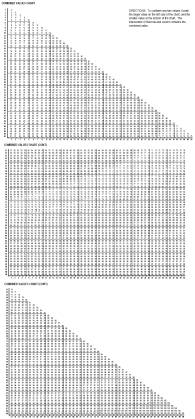
A few weeks ago I posted about the Multiple Disabilities Table for combining disabilities with injuries prior to 2005.
For injuries after 2005 we must turn to the 2005 Permanent Disability Rating Schedule. When combining disabilities for injuries after 2005 there are several possible alternatives. You can:
California Court of Appeals, First Appellate District
The First Appellate District of the Court of Appeal of the State of California has affirmed the Workers’ Compensation Appeals Board in Benson v. WCAB and the Permanente Medical Group, affirmed (2/10/2009). The Court of Appeals held, in relevant part, that “[t]he Wilkinson doctrine is inconsistent with the apportionment reforms enacted by Senate Bill No. 899.”
The basic upshot is that barring “limited circumstances” each distinct industrial injury will require its own Award.
First Ogilvie and Almaraz/Guzman, now Benson? Its been an exciting two weeks to be a Workers’ Compensation attorney.
At the moment it requires four pieces of information:
FEC Rank (re: body part in question)
Standard disability (re: body part in question)
Post-injury earnings for Applicant
Post-injury earnings for employees similarly situated to Applicant
Once you add in that information, click “Calculate” and it should crunch through the formula and give you a response. The WCAB in Ogilvie suggested several possible outcomes to this formula:
The “Individualized Loss Ratio” for the injured worker is the same or within the range for the current FEC Rank for the affected body part. In this circumstance, the 2005 DFEC has not been rebutted.
The “Individualized Loss Ratio” for the injured worker is within the range of one of the other seven FEC Ranks. Here, the DFEC portion of the 2005 Permanent Disability Rating Schedulemight be rebutted.
The “Individualized Loss Ratio” for the injured worker is outside the range of all eight FEC Ranks. In this circumstance, you could end up with a new FEC Adjustment Factor much higher or lower than any FEC Adjustment Factor associated with the eight FEC Ranks. Here, the DFEC portion of the 2005 Permanent Disability Rating Schedulemight be rebutted.
Obviously, there are innumerable factors that go into considerations of whether a Judge (or the WCAB) would find the DFEC portion of the 2005 Permanent Disability Rating Schedule to be rebutted. This calculation and the information relied upon in performing this calculation cannot be taken as a guarranteed method of rebutting the DFEC portion of the 2005 Permanent Disability Rating Schedule.